

Office of Attorney General teaming with business partners on STOP sign awareness campaign at Pa. ATMs
HARRISBURG — During National Cryptocurrency Month this October, Attorney General Dave Sunday is warning Pennsylvanians about scammers who use threats of arrest, phony investment opportunities, and online romance prospects to convince consumers to send money via cryptocurrency.
Attorney General Sunday announced a STOP sign awareness campaign during a community event in East Stroudsburg alongside Sen. Rosemary Brown (R-40), who attended in support of efforts to protect consumers from cryptocurrency-related fraud.
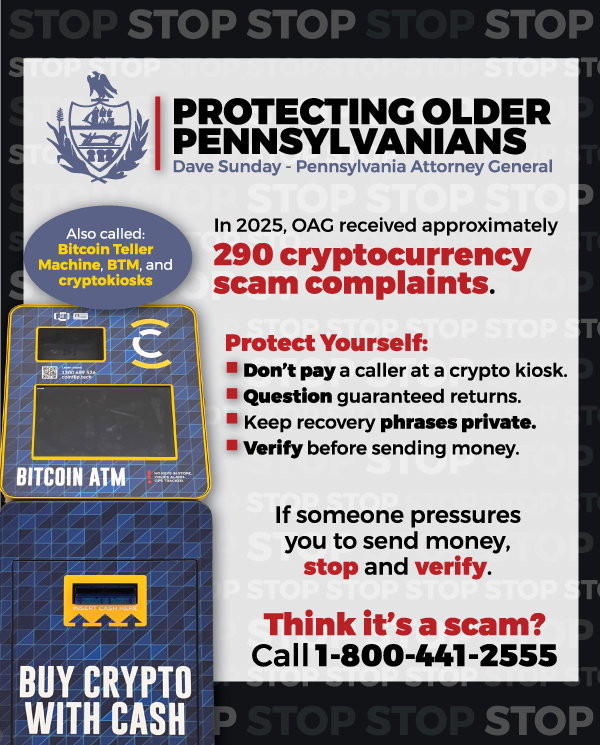
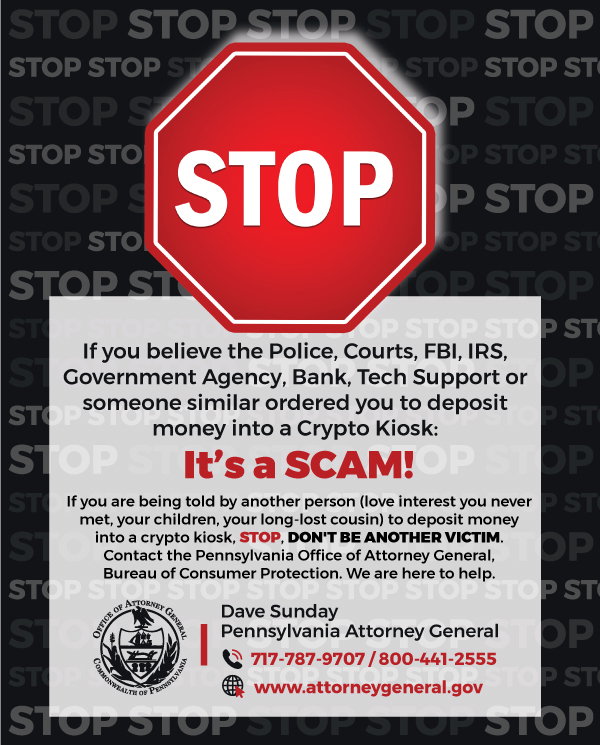
The STOP sign campaign will place warning signage at cryptocurrency and Bitcoin ATMs across the Commonwealth to help interrupt scams before transactions occur. The Office of Attorney General is strongly encouraging businesses that offer these machines to prominently display the signs, reminding consumers to stop before following instructions from unexpected callers, scanning QR codes or sending money under pressure.
The signage is available for download here and here.
Although cryptocurrency kiosks are located throughout the Commonwealth, many Pennsylvanians, especially older residents, may not be familiar with them — and why scammers prefer them as a method of payment.
Last year, the Office of Attorney General’s Bureau of Consumer Protection received about 290 scam complaints involving cryptocurrency. Most commonly, the scams involved investment or romance opportunities, and some employed threats and other scare tactics.
“Although the means of payment are different, the lures for these scams are the same. We really want to spread the word and warnings about solicitations involving cryptocurrency,” Attorney General Sunday said. “Criminals rely on fear and pressure to get victims to act before asking questions. If you receive an unexpected ask or directive to make a cryptocurrency transfer or deposit, stop and cease that communication. If you believe you have been targeted, contact my office. We are here to help.”
“In this ever-changing world, protecting our residents from scams and fraud is extremely important,” Sen. Brown said. “I sincerely appreciate Attorney General Sunday’s dedication to this important work and his continued efforts to keep Pennsylvanians informed and protected. His commitment to identifying emerging scams and bringing awareness to both the Legislature and the public helps empower our communities with the knowledge they need to recognize these threats and protect themselves and their loved ones.”
Cryptocurrency is a form of digital currency that can be purchased online or at kiosks, sometimes called Bitcoin ATMs. Scammers direct consumers to these machines to convert cash into cryptocurrency and send it to a wallet controlled by the scammer.
These transactions happen quickly and are often not traceable as a traditional bank withdrawal or transfer may be, making it very difficult for investigators to retrieve the victim’s losses.
“Cryptocurrency is the latest front in the longstanding battle against consumer fraud,” Alex Baloga, President and CEO of Pennsylvania Food Merchant Association (PFMA), said. “PFMA remains committed to protecting our members from fraud and the public, our members’ customers, from abuse. We value our partnership with OAG and law enforcement across Pennsylvania to raise awareness about crypto fraud schemes and equip the retail community to fight back against this novel threat.”
Attorney General Sunday’s Bureau of Consumer Protection has seen an uptick this year in government imposter scams involving callers who pose as representatives of county sheriff’s offices. Those scams often include a threat of arrest, and demand deposits into a Bitcoin ATM using a QR code provided by the scammer.
No legitimate law enforcement agency or court will direct you to a cryptocurrency kiosk to pay a fine, resolve a warrant, or avoid arrest.
- In one instance, a Pennsylvanian received a (fraudulent) call that appeared to come from a local police department regarding an outstanding warrant. The target was ordered to purchase $4,000 in cryptocurrency through a kiosk, which they did. That currency was sent to a scammer. Our office was able to retrieve back some of that money.
- Other scams begin with a relationship developed over social media or a messaging app. In one case, a consumer reported sending $81,000 through wire transfers for purported cryptocurrency investments after developing a romantic relationship with someone on WhatsApp. The scammer said the investments were for their future together. The consumer realized it was a scam when he could not withdraw the money without paying more.
“These scams are heartbreaking stories as they often involve a victim who is scared or thinks they have a sound investment opportunity — only to then discover their hard-earned dollars went to a scammer,” Attorney General Sunday said. “And it is so challenging to claw back the money after it is sent, that is why education and awareness are essential.”
Attorney General Sunday offers the following tips to help Pennsylvanians protect themselves:
- Do not act on demands to use a cryptocurrency kiosk. Police, courts, banks, and legitimate technical support representatives will not instruct you to deposit cash into a crypto kiosk to resolve an emergency or protect your money.
- Verify unexpected calls and messages independently. Caller ID can be manipulated to display a legitimate phone number. Hang up and contact the agency or business using a number from its official website. If the caller claims to be someone you know but you are suspicious, call that person back on a number you know they use.
- Be cautious when an online relationship turns to investing. Someone you have never met who offers to teach you about cryptocurrency or pressures you to invest may be trying to steal your money.
- Watch for promises of guaranteed profits and demands for additional payments. Fraudulent platforms may display fake earnings, then block withdrawals or demand supposed taxes or fees before releasing funds.
- Protect your accounts. Use two-factor authentication and never share passwords, private keys, or recovery phrases that provide access to your cryptocurrency wallet.
- Research before sending money. Independently review the company or platform and understand its transaction and conversion fees. Do not rely solely on links, testimonials, or instructions provided by someone encouraging you to invest.
Consumers who believe they have been targeted should stop sending money and report the incident promptly. Keep messages, transaction receipts, and any wallet addresses or QR codes used in the transaction.
Consumers may submit a complaint to the Office of Attorney General’s Bureau of Consumer Protection at www.attorneygeneral.gov, by emailing scams@attorneygeneral.gov, or by calling 1-800-441-2555.
###